


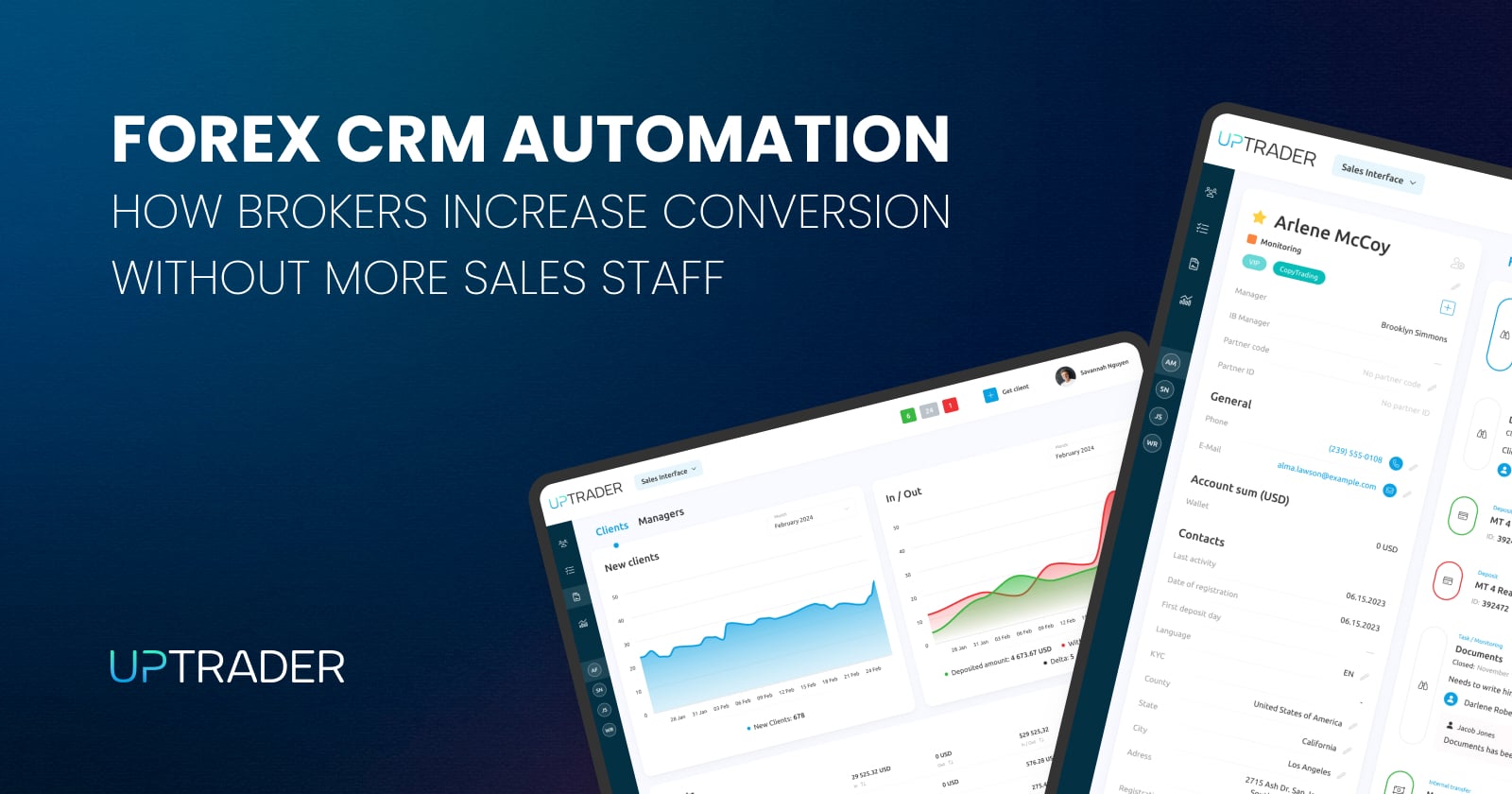
Forex CRM Automation: How Brokers Increase Conversion Without More Sales Staff
Share this publication:
You are spending money to acquire leads. Paid search, social ads, IB referrals, organic traffic. Those leads arrive at your registration page, and from that moment, every minute of delay between their first interaction and their first funded trade is a minute where you are losing them. Not because they found a better spread or a shinier platform. Because nobody responded fast enough, and this is an issue which is solved by Forex CRM.
Industry data shows that up to 70 percent of potential clients abandon the registration process when onboarding is slow or friction-heavy. That means for every 100 leads your marketing generates, up to 70 may never become funded accounts, not because your product was wrong, but because your follow-up process was too slow, too manual, or too generic to hold their attention.
The solution is not more sales staff. It is Forex CRM automation that acts on every lead the moment they enter your system, segments them based on behavior, and triggers the right action at the right time without a human needing to initiate it.
You can also read our in depth guides about Forex CRM software selection, providers, integration with trading platforms, white-label options, and other details in our articles section.
The Before and After of Forex CRM Usage
Here is what the lead-to-client journey looks like in a brokerage without Forex CRM automation:
A lead registers on your website. The registration sits in a queue until someone on your sales team reviews it, which could be minutes or hours depending on workload and time zones. The sales agent manually checks the lead's information, sends a welcome email, and maybe makes a call. If the lead does not answer, the agent moves on to the next task. The lead goes cold. Nobody follows up systematically. The marketing spend that generated that lead is wasted.
Now here is the same journey with Forex CRM automation:
A lead comes on board. In seconds, it scores the lead using its method of gathering data with respect to country of residence, trading experience given, and source of acquisition. The lead is then routed to the respective sales agent following rules set up based on geography, language, and potential account size. In addition, a welcome sequence is triggered. If a lead fails to register within 30 minutes, an email informing of abandonment is sent. If a lead has successfully registered but does not upload the KYC documents within 24 hours, a reminder is sent. If a lead manages to complete KYC but fails to deposit within 48 hours, he gets a special prompt with deposit instructions and the ways and means available to deposit money. The sales agent receives a prioritized task list showing exactly which leads need human attention and which are being handled by automation.
The result is not that automation replaces your sales team. It is that automation handles the 60 to 80 percent of routine touchpoints that currently consume your team's day, freeing them to focus on the high-value conversations that actually require a human.
Abandoned Registration Recovery
Registration abandonment is the single largest conversion leak in most brokerages, and it is almost entirely addressable through automation.
A potential client lands on your registration page, fills in their name and email, and then leaves. Maybe they got distracted. Maybe the form was too long. Maybe they opened a competitor's page in another tab. Without automation, that lead is gone. Your sales team does not even know they existed because the registration was never completed.
With Forex CRM automation, the partial registration is captured. An abandonment recovery sequence triggers automatically: a reminder email within 30 minutes, a follow-up within 24 hours, and if neither converts, a final message within 72 hours. These are not generic marketing emails. They reference the specific step where the client stopped and provide a direct link to resume exactly where they left off.
Brokerages that implement registration abandonment recovery typically recapture 10 to 15 percent of abandoned registrations. On a base of 1,000 monthly abandoned registrations, that is 100 to 150 additional leads re-entering your funnel without any incremental acquisition spend.
Incomplete KYC Follow-Up
The gap between registration and KYC completion is the second major conversion leak. A client registers, receives their login credentials, and then does not upload their identity documents. Every day of delay between registration and funded account is a measurable drop in conversion probability.
Automated KYC follow-up works on a timed sequence. If documents have not been uploaded in the allowed timeframe, the Forex CRM sends a reminder with clear instructions and a direct link. If a document has been rejected due to bad quality of a picture, expiration, or name mismatch, the Forex CRM notifies the client immediately and explains the cause as well as saying to upload the documents again. If a client has uploaded one document and not the other, the reminder specifies only the missing document.
The difference between automated KYC following and manual following is speed and unambiguity. An automated system sends the right message at the right time for every single client. A manual process depends on which compliance officer is on duty, how full their queue is, and whether they remember to follow up on the pending submission from yesterday.
Automated verification workflows can reduce onboarding time by up to 60 percent compared to manual processes. That compression directly increases the percentage of registered leads who reach funded account status.
Inactive Trader Reactivation
Client acquisition is expensive. Reactivating a dormant trader costs a fraction of acquiring a new one. But most brokerages handle reactivation through periodic batch campaigns that send the same generic message to every inactive account, regardless of why the client stopped trading.
Forex CRM automation enables behavior-triggered reactivation. The system monitors trading activity continuously. When an account crosses a defined inactivity threshold, 7 days, 14 days, 30 days, it triggers a response calibrated to the client's specific situation.
A high-value trader whose activity dropped after a losing streak receives a different message than a new client who funded their account but never placed a first trade. A client who has been inactive for 14 days gets a lighter touch than one who has not logged in for 60 days. The Forex CRM can see trading history, deposit patterns, and last login data. Automation uses that context to determine what to send and when.
The impact is measurable. Brokerages using behavior-triggered reactivation workflows report meaningfully higher reactivation rates compared to batch email campaigns, because the outreach is timely, relevant, and connected to the client's actual behavior rather than a calendar-driven schedule.
Deposit Reminders and Funding Nudges
A client who has completed registration and KYC but has not yet deposited is sitting at the highest-intent, highest-risk moment in the conversion funnel. They have done the work. They are verified. They are one step away from becoming a revenue-generating account. And they are also one distraction away from never coming back.
Automated deposit reminders address this gap directly. A sequence triggers when a verified client has not funded within a defined window. The first message highlights available deposit methods and processing times. A follow-up might surface a relevant promotion or bonus if your brokerage offers one. A final message might include a direct link to the deposit page with the client's preferred payment method pre-selected.
These are not aggressive sales messages. They are operational nudges that remove friction between a decision the client has already made and the action they have not yet completed.
What Forex CRM Means for Your P&L
The financial case for Forex CRM automation is straightforward. You are already paying to generate leads. Automation increases the percentage of those leads that convert to funded accounts without increasing your acquisition spend or your headcount.
A brokerage generating 2,000 leads per month with a 15 percent registration-to-funded conversion rate produces 300 funded accounts. If Forex CRM automation improves that conversion rate by even 5 percentage points, to 20 percent, the same 2,000 leads produce 400 funded accounts. That is 100 additional funded accounts per month with zero incremental acquisition cost and zero additional sales staff.
Industry benchmarks suggest that well-implemented Forex CRM automation can enable two to three times higher agent productivity by eliminating manual follow-up tasks and letting your team focus on the conversations that require human judgment. The automation handles volume. Your team handles value.
Learn more about UpTrader Forex CRM here.